
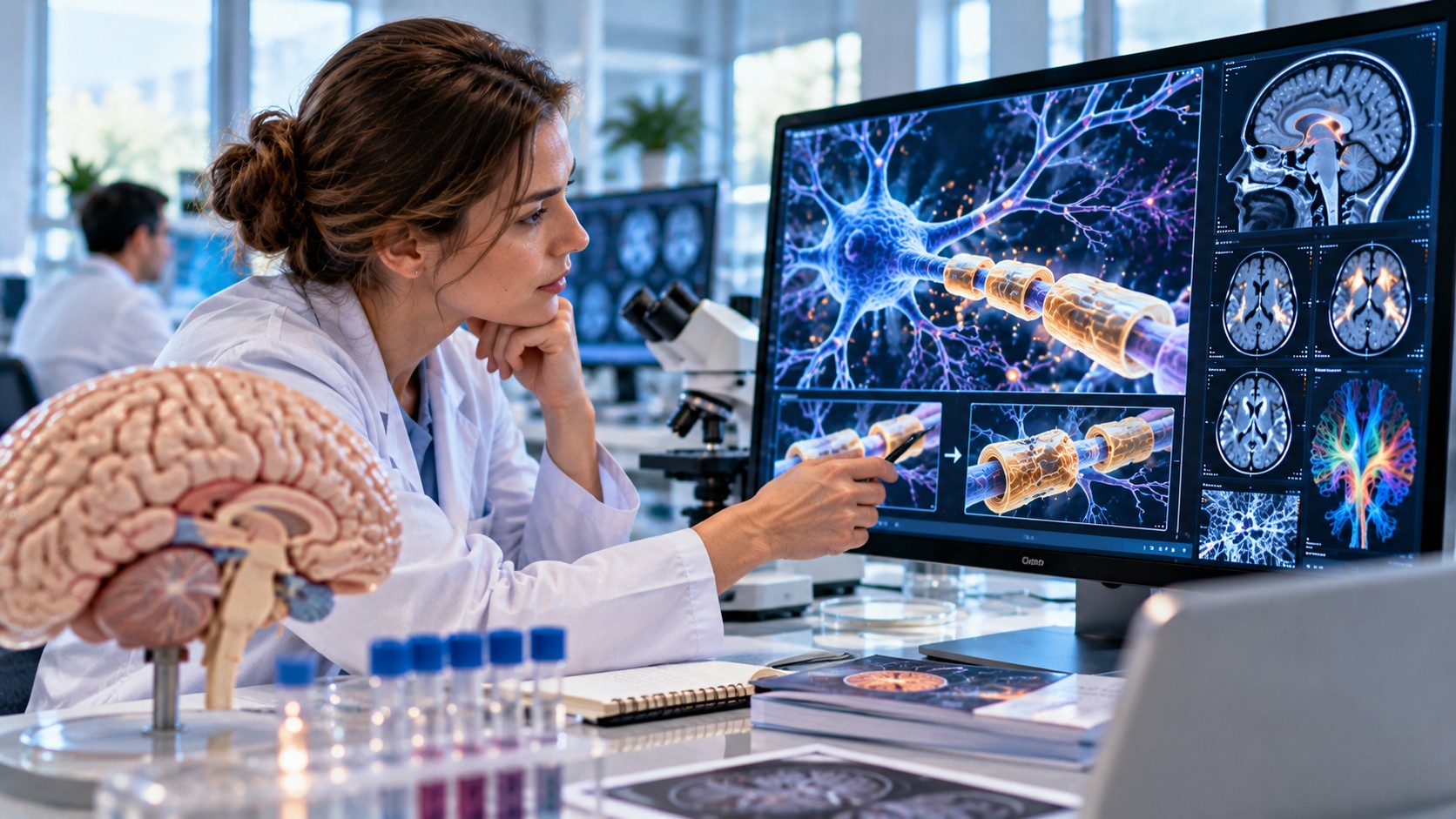
Myelin is often described as insulation around nerve fibers, but its role is far more important than that simple comparison suggests. It helps electrical signals travel efficiently through the nervous system and supports the long-term function of axons. When this protective structure is damaged, communication between different parts of the nervous system can become disrupted.
In Multiple Sclerosis, inflammation and immune activity can contribute to myelin injury. The body can attempt to repair some of this damage through remyelination, but the process is not always complete. This has made the environment surrounding damaged nerve fibers an important focus of regenerative medicine research.
Why the Myelin Environment Matters
Myelin does not exist independently. It is maintained through interactions between oligodendrocytes, precursor cells, neurons, immune cells, and other components of nervous tissue.
Following a lesion, precursor cells can become involved in remyelination. Yet successful repair depends on whether these cells can survive, migrate toward damaged areas, mature appropriately, and establish functional connections with affected nerve fibers.
Inflammation can complicate each of these steps. A persistent inflammatory environment may interfere with the biological conditions needed for efficient repair.
This is why researchers are asking a broader question: rather than focusing only on replacing lost myelin, can the surrounding cellular environment be influenced to support the body’s own repair mechanisms?
How Stem Cell Research Approaches Remyelination
Stem cell research does not necessarily mean that transplanted cells will directly become new oligodendrocytes. Some cellular approaches are being investigated because of their ability to communicate with surrounding tissues.
Certain stem and stromal cell populations can release signaling molecules that influence immune activity, cell survival, and tissue responses. These effects have led researchers to examine whether cellular therapies could indirectly support an environment that is more compatible with remyelination.
The Bulgarian STEM PLUS center works with cellular and regenerative medicine while combining clinical activity with biotechnology capabilities. Its approach and information about its work can be found at https://stemplus.clinic/.
Signaling May Be as Important as Cell Replacement
A major shift in regenerative research has been the growing interest in cell-to-cell communication.
Cells can release growth factors, cytokines, extracellular vesicles, and other biological signals. These molecules may influence neighboring cells without the introduced cells becoming permanent components of the repaired tissue.
For Multiple Sclerosis research, this raises several questions:
- Could cellular signals influence excessive inflammation?
- Can they support the survival of cells involved in remyelination?
- Might they affect communication between immune and neural cells?
- Could the local tissue environment become more supportive of repair?
The answers remain under investigation, and different cellular technologies may produce very different biological effects.
The Role of Oligodendrocytes
Oligodendrocytes are central to myelin biology in the central nervous system. They produce the myelin sheaths that surround many nerve fibers and help maintain efficient neural signaling.
When myelin is damaged, precursor cells can potentially contribute to its restoration. However, remyelination becomes more difficult when lesions are extensive or repeated and when the surrounding environment contains persistent inflammatory signals.
This makes oligodendrocyte biology particularly relevant to regenerative research. Scientists are studying how precursor cells behave after injury and which factors determine whether remyelination succeeds or remains incomplete.
Myelin Repair Is Not the Same as Full Recovery
Even successful remyelination would not necessarily mean that every neurological symptom disappears.
The extent of recovery depends on the condition of the underlying axon. If a nerve fiber remains viable, restoring its myelin may help improve its ability to conduct signals. Significant axonal degeneration presents a much more difficult biological problem.
For this reason, research into Multiple Sclerosis stem cell treatment often considers several potential objectives at once. These can include immunomodulation, neuroprotection, support for tissue repair, and interaction with the mechanisms responsible for remyelination.
These concepts should not be confused with a guarantee of neurological restoration.
Creating Better Conditions for Natural Repair
One of the most interesting ideas in cellular medicine is that regeneration may depend partly on changing the environment around damaged tissue.
If inflammation, cellular stress, and unfavorable signaling interfere with remyelination, then influencing those factors could theoretically help endogenous repair mechanisms function more effectively.
This does not mean that a cellular intervention can simply rebuild damaged myelin on demand. Instead, researchers are investigating whether biological signals can make the environment more supportive of processes that are already present in the nervous system.
Why Patient Biology Matters
The capacity for remyelination can differ between individuals and may also change as the disease progresses. Disease duration, lesion characteristics, accumulated neurological damage, inflammatory activity, and general health can all influence the biological context.
Therefore, cellular approaches need to be considered in relation to the individual rather than as a single universal treatment.
Where the Research Is Going
Future advances may come from a better understanding of the relationship between immune regulation, oligodendrocyte precursor cells, neurons, and the molecular signals exchanged within damaged tissue.
The central challenge is to determine which cellular mechanisms genuinely support functional repair and how those mechanisms can be measured in clinical settings.
For Multiple Sclerosis, this could shift the focus from simply managing the consequences of myelin damage toward understanding how the nervous system might be given better conditions in which to repair itself. The most important discoveries may ultimately involve not just replacing damaged structures, but learning how to influence the complex biological environment that determines whether repair can occur.